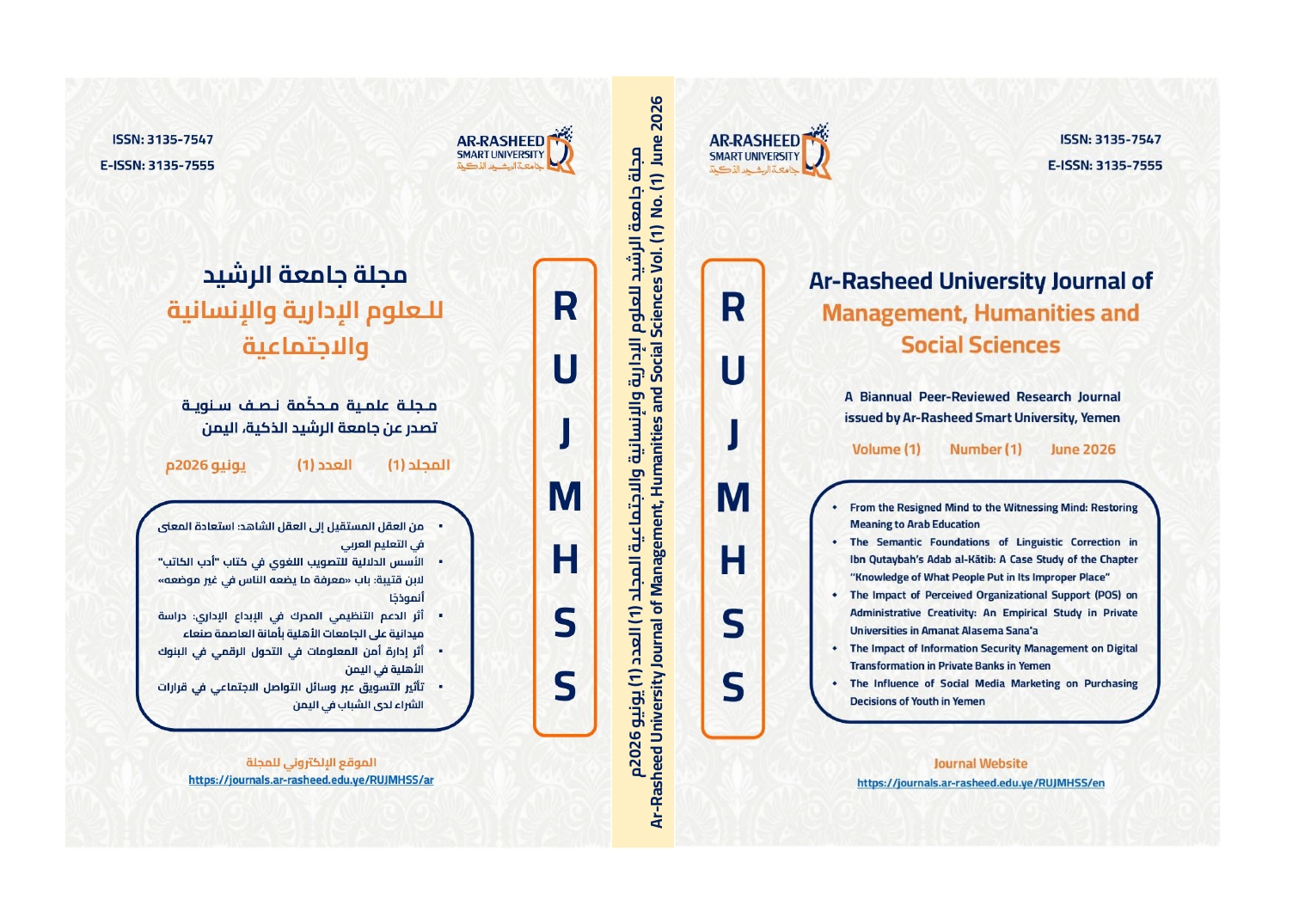
From the Resigned Mind to the Witnessing Mind: Restoring Meaning to Arab Education
DOI:
https://doi.org/10.67151/rujmhss.v1i1.18Keywords:
Arab education, resigned mind, witnessing mind, transformative learning, critical thinking, artificial intelligence in educationAbstract
This paper explores the crisis of meaning in contemporary Arab education, where the abundance of accessible information is accompanied by a noticeable decline in deep understanding. It argues that current educational practices produce a “resigned mind,” characterized by passive reception of knowledge rather than critical engagement. This condition is rooted in pedagogical coercion, rote memorization, and what Paulo Freire terms “banking education,” where learners are treated as repositories of information rather than active participants in knowledge construction. Drawing on both classical and modern thought—from Ibn Khaldun and Muhammad Abduh to Dewey and Gert Biesta—the paper situates this crisis within a broader intellectual and cultural context. It further examines how the rise of artificial intelligence intensifies the problem by promoting a model of “learnification,” which reduces education to measurable outcomes and neglects the formation of autonomous, critical, and ethically responsible individuals. To address this challenge, the paper proposes an integrative framework that combines Activity Theory, the Community of Inquiry model, and Transformative Learning. This framework aims to reconstruct the educational process by restoring human presence, fostering critical inquiry, and enabling deep shifts in learners’ perspectives. Ultimately, the paper calls for a transition from the “resigned mind” to the “witnessing mind,” capable of producing meaning and engaging responsibly with knowledge.
References
ابن خلدون، ع. م. (2004). المقدمة (ع. م. الدرويش، تحقيق). دار يعرب.
بن نبي، م. (1986). شروط النهضة (ع. شاهين وع. ك. مسقاوي، ترجمة). دار الفكر. (العمل الأصلي نشر بالفرنسية عام 1949). https://app.turath.io/book/21841
الجابري، م. ع. (1984). تكوين العقل العربي. مركز دراسات الوحدة العربية.
الجابري، م. ع. (1986). بنية العقل العربي. مركز دراسات الوحدة العربية.
حسين، ط. (2014). مستقبل الثقافة في مصر. مؤسسة هنداوي. (العمل الأصلي نشر في 1938). DOI: https://doi.org/10.21608/ins.2014.234690
حيدر، ع. (2016). البحث الإجرائي: بين التفكر في الممارسة المهنية وتحسينها. مكتبة الجيل الجديد.
عباس، ك. (2012). الوجود والزمان عند هيدجر وكانت. دار الفكر الفلسفي.
عبد الرحمن، ط. (2000). سؤال الأخلاق: مساهمة في النقد الأخلاقي للحداثة الغربية. المركز الثقافي العربي.
عبد الرحمن، ط. (2006). روح الحداثة: المدخل إلى تأسيس الحداثة الإسلامية. المركز الثقافي العربي.
عبده، م. (1993). الأعمال الكاملة (م. عمارة، جمع وتحقيق). دار الشروق. (الأعمال الأصلية نشرت في أوائل القرن العشرين).
العقاد، ل. (2003). الأسس المعرفية والتكنولوجية للفكر التربوي العربي المعاصر. المنظمة العربية للتربية والثقافة والعلوم.
قطامي، ي. (2013). استراتيجيات التعلم والتعليم المعرفية. دار المسيرة للنشر والتوزيع.
Biesta, G. J. J. (2013). The beautiful risk of education. Routledge.
Biesta, G. J. J. (2017). The rediscovery of teaching. Routledge. DOI: https://doi.org/10.4324/9781315617497
Dewey, J. (1916). Democracy and education: an introduction to the philosophy of education. The Macmillan Company.
Engeström, Y. (1987). Learning by expanding: an activity theoretical approach to developmental research. Orienta-Konsultit.
Engeström, Y. (2001). Expansive learning at work: toward an activity theoretical reconceptualization. Journal of Education and Work, 14(1), 133–156. https://doi.org/10.1080/13639080020028747 DOI: https://doi.org/10.1080/13639080020028747
Engeström, Y. (2015). Learning by expanding: an activity-theoretical approach to developmental research (2nd ed.). Cambridge University Press. DOI: https://doi.org/10.1017/CBO9781139814744
Freire, P. (1970). Pedagogy of the oppressed. Continuum.
Garrison, D. R., Anderson, T., & Archer, W. (1999). Critical inquiry in a text-based environment: computer conferencing in higher education. The Internet and Higher Education, 2(2-3), 87–105. https://doi.org/10.1016/S1096-7516(00)00016-6 DOI: https://doi.org/10.1016/S1096-7516(00)00016-6
Kundera, M. (1996). La lenteur [Slowness]. Gallimard.
Mezirow, J. (1991). Transformative dimensions of adult learning. Jossey-Bass.
Mezirow, J. (2000). Learning as transformation: critical perspectives on a theory in progress. Jossey-Bass.
Mezirow, J. (2009). Transformative learning theory. In J. Mezirow & E. W. Taylor (Eds.), Transformative learning in practice: insights from community, workplace, and higher education (pp. 18-32). Jossey-Bass.
Said, E. W. (1994). Representations of the intellectual. Pantheon Books.
Said, E. W. (2004). Humanism and democratic criticism. Columbia University Press.
Vygotsky, L. S. (1978). Mind in society: the development of higher psychological processes. Harvard University Press.
Wertsch, J. V. (1991). Voices of the mind: a sociocultural approach to mediated action. Harvard University Press.
Wertsch, J. V. (1998). Mind as action. Oxford University Press. DOI: https://doi.org/10.1093/acprof:oso/9780195117530.001.0001
Wittgenstein, L. (1980). Culture and value (G. H. Wright & H. Nyman, Eds.; P. Winch, Trans.). University of Chicago Press. (Original work published 1977).
Downloads
Published
Issue
Section
License
Copyright (c) 2026 The Author. Published by Ar-Rasheed Smart University, Yemen

This work is licensed under a Creative Commons Attribution 4.0 International License.