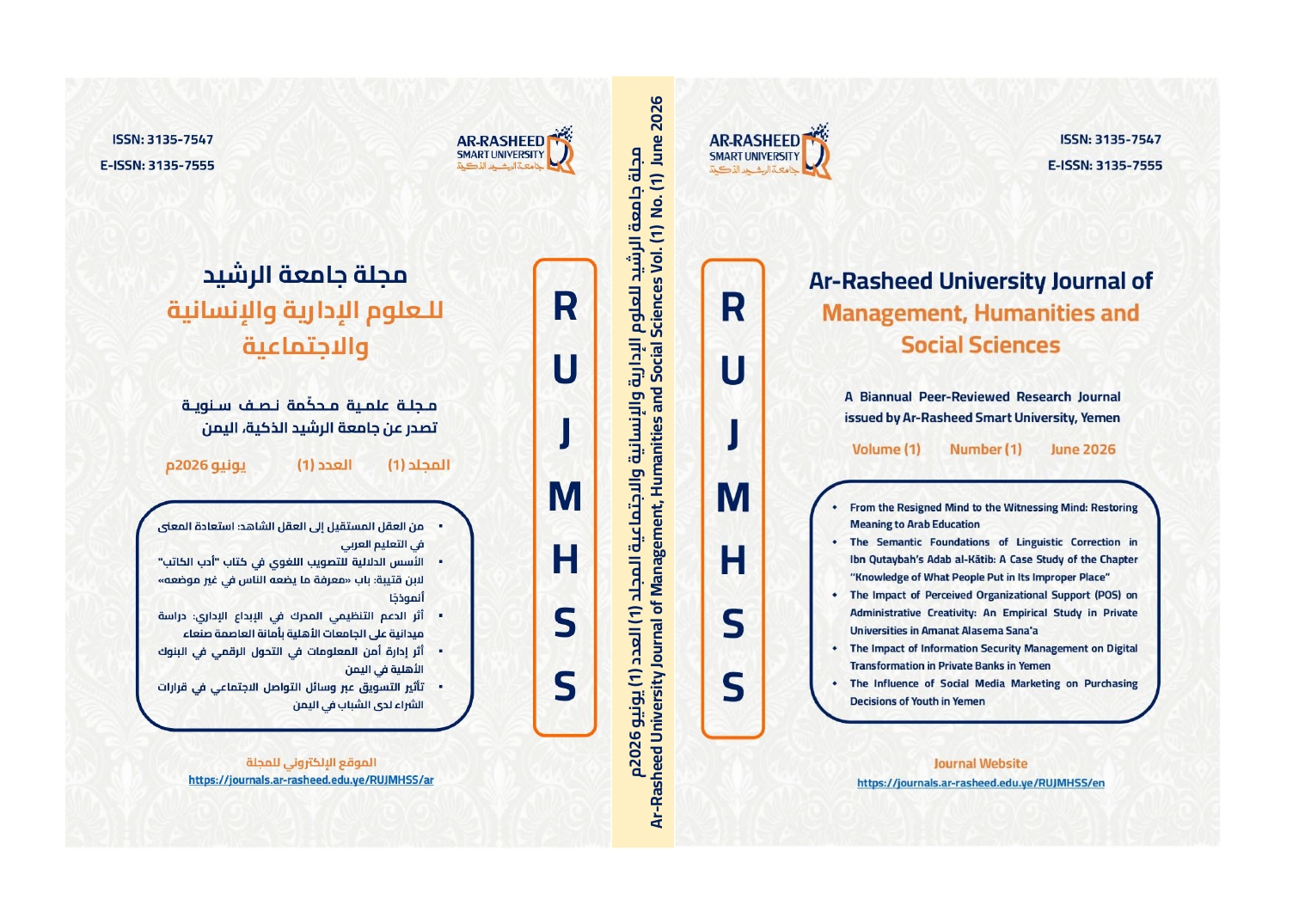
The Influence of Social Media Marketing on Purchasing Decisions of Youth in Yemen
DOI:
https://doi.org/10.67151/rujmhss.v1i1.23Keywords:
Social media marketing, purchase decisions, Yemeni university students, technology acceptance model, theory of planned behaviorAbstract
Social media has become an important channel through which consumers obtain product information and interact with brands, yet evidence from Yemen remains limited. This cross-sectional study examined whether five complementary predictors drawn selectively from TAM and TPB - perceived benefits, perceived ease of use, attitude, subjective norms, and social media marketing - were associated with purchase decisions. The study used a sample of 150 respondents. All were students enrolled at Ar-Rasheed Smart University in Sana'a and originated from several Yemeni governorates. Data were collected through a structured questionnaire and analyzed using descriptive statistics, one-sample t tests, Pearson correlations, and simple and multiple linear regression. The composite social media-related score was positively associated with purchase decisions and explained 30.4% of their variance. It also showed that attitude and social media marketing were statistically significant predictors, whereas perceived benefits, ease of use, and subjective norms were not. The findings suggest that favorable attitudes and the quality of marketing content are more closely related to purchase decisions among the surveyed sample than perceptions of usefulness or ease of use. The cross-sectional design does not support causal inference.
References
Ajzen, I. (1991). The theory of planned behavior. Organizational Behavior and Human Decision Processes, 50(2), 179–211. https://doi.org/10.1016/0749-5978(91)90020-T
Al-Halili, A., & Hongxin, L. (2019). E-commerce and internet marketing in Yemen: opportunities and challenges. European Journal of Business and Management, 11(21), 23–32. https://doi.org/10.7176/EJBM/11-21-04
Basri, W. (2016). Social media impact on small and medium enterprise: case review of businesses in the Arab world. Arts and Social Sciences Journal, 7(6), 1000236. https://doi.org/10.4172/2151-6200.1000236
Berthon, P. R., Pitt, L. F., Plangger, K., & Shapiro, D. (2012). Marketing meets web 2.0, social media, and creative consumers: Implications for international marketing strategy. Business Horizons, 55(3), 261–271. https://doi.org/10.1016/j.bushor.2012.01.007
Bin-Obaidellah, S. S. A., Mokhtar, N. F., Awi, N. A., & Mokhlis, S. (2023). The effect of ICT infrastructure on business performance of micro and small enterprises in Yemen: the moderating effect of social media marketing. International Journal of Procurement Management, 18(1), 44–67. https://doi.org/10.1504/ijpm.2023.132590
Davis, F. D. (1989). Perceived usefulness, perceived ease of use, and user acceptance of information technology. MIS Quarterly, 13(3), 319–340. https://doi.org/10.2307/249008
Hanna, R., Rohm, A., & Crittenden, V. L. (2011). We’re all connected: the power of the social media ecosystem. Business Horizons, 54(3), 265–273. https://doi.org/10.1016/j.bushor.2011.01.007
Hendricks, S., & Mwapwele, S. D. (2024). A systematic literature review on the factors influencing e-commerce adoption in developing countries. Data and Information Management, 8(1), 100045. https://doi.org/10.1016/j.dim.2023.100045
Kaplan, A. M., & Haenlein, M. (2010). Users of the world, unite! The challenges and opportunities of social media. Business Horizons, 53(1), 59–68. https://doi.org/10.1016/j.bushor.2009.09.003
Munassar, N. M. A., & Mohammed, A. F. M. (2024). The reality of e-commerce and digital marketing in the Yemeni market: opportunities and challenges. Engineering and Technology Journal, 9(10), 5452–5455. https://doi.org/10.47191/etj/v9i10.30
Pavlou, P. A. (2003). Consumer acceptance of electronic commerce: Integrating trust and risk with the technology acceptance model. International Journal of Electronic Commerce, 7(3), 101–134. https://doi.org/10.1080/10864415.2003.11044275
Saleh, M. A. K., Manjunath, K. R., & Qaied, M. M. M. (2021). The role of social media in SME's performance: Evidences from Yemen. The Social Science Dialogue, 1(2), 7-28.
Tshabukole, F. T. (2022). The impact of social media marketing on consumers online purchase behaviour. A thesis submitted to the Institute of Graduate Studies in partial fulfillment of the requirements for the Degree of Master of Business Administration, Final International University, Girne, Turkish Republic of Northern Cyprus.
Venkatesh, V., & Davis, F. D. (2000). A theoretical extension of the technology acceptance model: four longitudinal field studies. Management Science, 46(2), 186–204. https://doi.org/10.1287/mnsc.46.2.186.11926
Downloads
Published
Issue
Section
License
Copyright (c) 2026 The Authors. Published by Ar-Rasheed Smart University, Yemen

This work is licensed under a Creative Commons Attribution 4.0 International License.